How to Reduce the Risk of Cargo Damage in International Transport
How to Reduce the Risk of Cargo Damage in International Transport
Once a shipment leaves the supplier’s warehouse, product quality is only part of the equation. Packaging, loading, route conditions, terminal handling and final unloading all affect the condition of the goods on arrival. A minor impact may break a component; poorly distributed weight may crush cartons; moisture or temperature changes can cause damage that remains hidden until the packages are opened.
Preventing cargo damage is not a single task performed at the loading point. It requires a plan for the entire transport chain, from preparation and packing to delivery and inspection. This guide explains the main risks and the practical steps shippers, packers, carriers and consignees can take to protect a shipment.
What types of cargo damage can occur?
Damage is not limited to visible breakage. It may affect appearance, performance or shelf life, and it may only become apparent after unpacking. Common examples include:
- Impact and drops: caused by rough handling, forklift contact or unsecured packages.
- Compression: when cartons are stacked beyond their strength or heavy goods are placed on weaker packages.
- Water and moisture: from rain, leaks, container condensation or contact with wet cargo.
- Vibration and shifting: particularly on long road journeys or during repeated intermodal transfers.
- Temperature excursions: affecting food, pharmaceuticals, chemicals and other temperature-sensitive products.
- Contamination and odour: when incompatible, leaking or strongly scented cargo is stowed together.
- Theft or tampering: which can result in missing goods, opened packages or broken seals.
The likely damage mechanism should guide the choice of packaging, equipment and load-securing method.
1. Match the packaging to the product and the journey
Export packaging must protect the goods throughout the transport chain, not merely during the first handover. A package may be lifted several times, palletised, loaded into a container and transferred between terminals. Its strength should reflect the product’s weight, dimensions, fragility, value and sensitivity.
Use suitable cushioning, internal partitions and controlled void space for fragile items. Machinery and metal components need protection against movement and contact with adjacent parts. Moisture-sensitive goods may require a suitable barrier layer, sealed inner packaging or desiccants. More packaging is not automatically better: excess weight and dimensions can increase freight costs and make handling more difficult.
For additional guidance, see our article on standard packaging for exporting goods.
2. Plan the stowage and secure the load
Even well-packed goods can be damaged if they move inside a truck or container. The load should remain stable during acceleration, braking, cornering, vibration and terminal handling. Control empty spaces and use appropriate blocking, bracing, lashing, straps, dunnage or anti-slip materials to prevent sliding, tipping and impact.
Distribute weight sensibly across the floor. Avoid placing heavy packages on top of weaker cartons or stacking above the packaging’s rated capacity. Keep the centre of gravity as low and stable as practical, and use suitable securing points. Heavy machinery, project cargo and out-of-gauge shipments need a load-securing plan prepared by people familiar with the cargo and equipment.
The IMO/ILO/UNECE Code of Practice for Packing of Cargo Transport Units (CTU Code) provides practical guidance on planning, weight distribution and securing cargo in containers and other transport units across road and sea legs. It is a non-mandatory code of practice and does not replace applicable mode-specific regulations. The official guidance is available from UNECE.
3. Inspect the vehicle or container before loading
Check the cargo space before use. It should be clean and dry, without unusual odours, holes, damaged flooring, visible leaks or defective doors. For cargo that needs ventilation or temperature control, confirm that the selected equipment is suitable and that its systems are working properly.
A container with a damaged floor or leaking roof can expose goods to risk even when the packaging is sound. Record defects and request a replacement or repair before loading. Our guide to types of shipping containers and their applications explains the main equipment options.
4. Control temperature and humidity throughout the route
Temperature-sensitive products should travel in equipment whose capacity and operating range match the product specification. The set point must follow the shipper’s or manufacturer’s instructions. Depending on the cargo, pre-cooling, loading at the correct product temperature, adequate air circulation and keeping return-air paths clear may be essential.
For sensitive shipments, a temperature or humidity data logger can provide a record of conditions during transit. Keep wet, leaking or moisture-generating goods separate from products that can be damaged by humidity. On sea journeys, temperature changes can cause condensation inside a closed container, so moisture management should be considered before loading.
For cold-chain shipments, read our guide to transporting goods with refrigerated trucks.
5. Agree on safe loading and unloading procedures
Damage often occurs during handling at warehouses, terminals or the consignee’s premises. Before loading, define the equipment required, package weights and dimensions, lifting points and any special forklift, crane or sling requirements. Lifting from an unsuitable point or using incorrectly positioned forklift forks can damage both the package and the product.
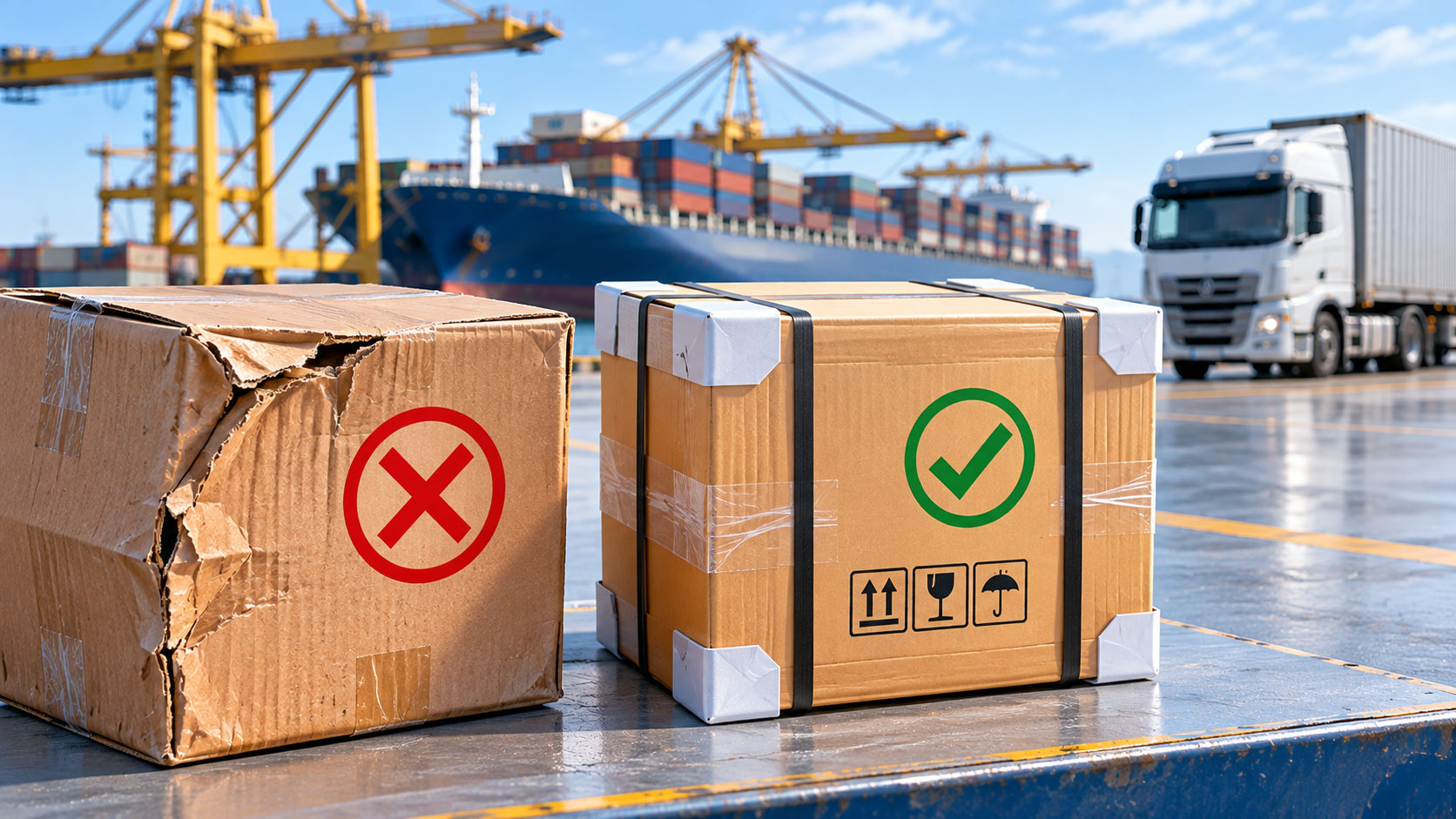
Use handling marks such as “Fragile”, “This Way Up” or “Keep Dry” when appropriate, but do not treat labels as a substitute for robust packaging and proper securing. The consignee should also receive unloading instructions so that packages do not shift unexpectedly when container doors are opened or lashings are released.
6. Record the cargo condition and transport details
Before closing a container or handing the shipment to the driver, take clear photographs of the packages, stowage, securing arrangements and the transport unit’s condition. Record package counts, marks, seal numbers and any visible pre-existing damage. For international road freight, accurate transport documents and clear notes about the apparent condition of the goods are important. See our guide to the CMR consignment note.
At delivery, the consignee should inspect the packages and quantities before signing the receipt. Note visible damage, shortages or broken seals specifically on the delivery receipt or transport document. Signing without recording discrepancies may make it harder to establish when and under what circumstances the damage occurred.
7. Understand cargo insurance and carrier liability
Cargo insurance and a carrier’s legal liability are not the same thing. Carrier liability depends on the contract, applicable conventions or local law, the transport mode and any legal limits. Cargo insurance responds according to the policy wording, insured value, covered risks and exclusions. It should never be assumed that every type of loss or cause of damage is automatically covered.
Before dispatch, disclose the cargo value, nature of the goods, packaging, route, transport mode and any special risks to the insurer. Review the scope of cover, deductible, exclusions, notification procedure and claim deadlines. If damage occurs, photograph the goods and packaging, preserve the seal and documents, notify the carrier and insurer promptly, and do not discard evidence before receiving instructions. A surveyor’s report may be required.
Pre-shipment checklist
- Packaging is suitable for the cargo, weight and route.
- Pallets, straps and securing equipment are in good condition and correctly rated.
- Weight is distributed evenly and empty spaces are controlled.
- The container or vehicle is clean, dry and free from significant defects.
- Temperature, humidity and ventilation requirements are addressed.
- Loading and unloading procedures and equipment are agreed.
- Photographs, seal numbers, package counts and visible condition are recorded.
- Insurance wording and claim notification deadlines have been reviewed.
What should you do if damage is discovered?
First protect people and prevent further loss. Record the condition before unnecessary movement, note damage or shortage on the delivery receipt, and notify the carrier, seller and insurer as soon as possible. Keep the damaged packaging, seal, photographs, unloading report, invoice, packing list and transport document. If the goods must be moved or repaired to prevent further damage, document the reason and costs, and coordinate with the insurer where practicable.
Claim notice periods and procedures are not identical across contracts and transport modes. Check the actual transport contract and policy, and seek specialist advice where a formal claim or legal action may be needed.
Frequently asked questions
What is the most common cause of cargo damage?
There is no single cause for every shipment. Inadequate packaging, poor load securing, rough handling, moisture and uncontrolled temperature are among the recurring risks. The cargo type and route determine which deserves the most attention.
Does a “Fragile” label prevent damage?
It warns handlers, but it cannot guarantee careful handling. Protective packaging, internal cushioning and proper load securing are still necessary.
Does cargo insurance cover every type of damage?
No. Cover depends on the policy wording, insured risks, exclusions, deductible and evidence supporting the claim. Review the terms before dispatch.
Why take photographs before loading?
Photographs can show the packaging, stowage, securing and equipment condition at handover. They may help establish when damage occurred and support a claim investigation.
Conclusion
Reducing cargo damage takes a series of coordinated decisions: packaging suited to the product, stable stowage and securing, fit-for-purpose transport equipment, control of environmental conditions, safe handling, accurate records and appropriate insurance. The more carefully these measures are planned before dispatch, the lower the likelihood of avoidable loss, disputes and unexpected costs at destination.
To discuss a suitable transport plan for your shipment, explore IRSA Darya Logistics international transport services.