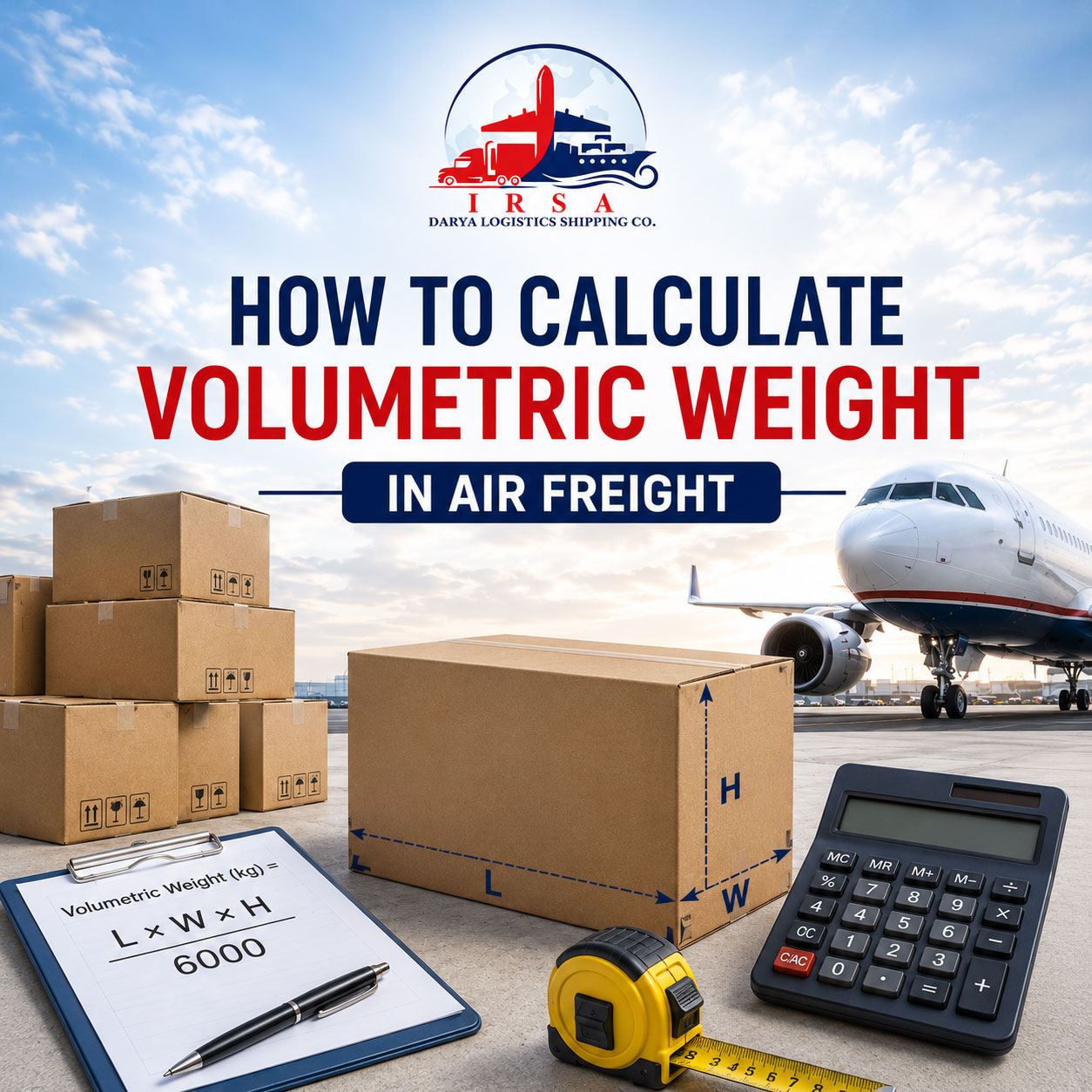
How to Calculate Volumetric Weight in Air Freight
How to Calculate Volumetric Weight in Air Freight: A Complete Guide with Formula, Examples, and Key Tips
In air freight transportation, the weight of the cargo is not the only factor used to determine shipping costs. Many shipments occupy a large amount of space inside an aircraft despite having a relatively low actual weight. For this reason, airlines use a concept known as volumetric weight calculation to calculate freight charges based on the space occupied by the shipment.
If you are an exporter, importer, or business owner using air freight services, understanding how to calculate volumetric weight can help you estimate shipping costs more accurately and avoid unexpected transportation expenses.
IRSA Darya Logistics provides professional international freight transportation services, including accurate volumetric weight calculations, selecting the most efficient shipping routes, and offering expert logistics consultation to help customers transport their cargo at the most competitive cost and within the shortest possible transit time.
What Is Volumetric Weight?
Before discussing how to calculate volumetric weight, it is important to understand what volumetric weight actually means.
Volumetric Weight, also known as Dimensional Weight, is a measurement that converts the space occupied by cargo inside an aircraft into an equivalent shipping weight. In other words, if a package is lightweight but occupies a significant amount of cargo space, the airline cannot charge only based on its actual weight because the shipment consumes valuable aircraft capacity.
Therefore, two values are always calculated for air freight:
- Actual Weight
- Volumetric Weight
Whichever value is greater becomes the chargeable weight used to calculate the freight cost.
Why Is Volumetric Weight Important?
Aircraft are limited not only by weight capacity but also by cargo space. Consider the following two shipments:
- A metal box weighing 100 kg with a small volume.
- A large foam box weighing only 15 kg but occupying a significant amount of space.
If shipping costs were calculated solely based on actual weight, the airline would lose money on the second shipment because it occupies much more cargo space. This is why the concept of volumetric weight was introduced in the air freight industry.
The Formula for Calculating Volumetric Weight
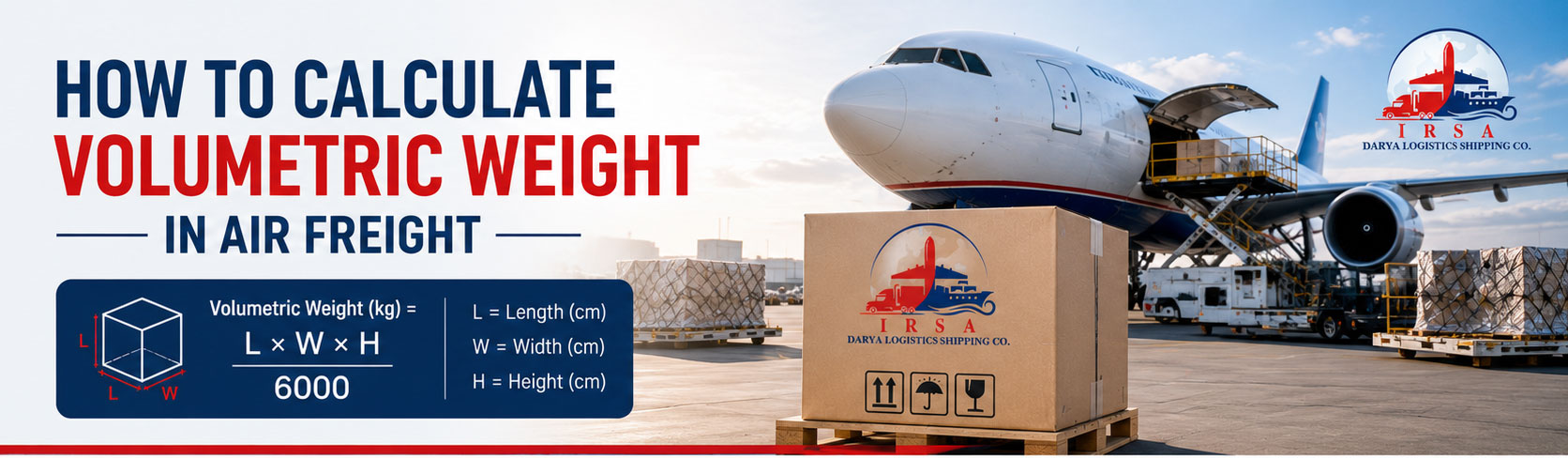
The most commonly used formula for volumetric weight calculation in air freight is:
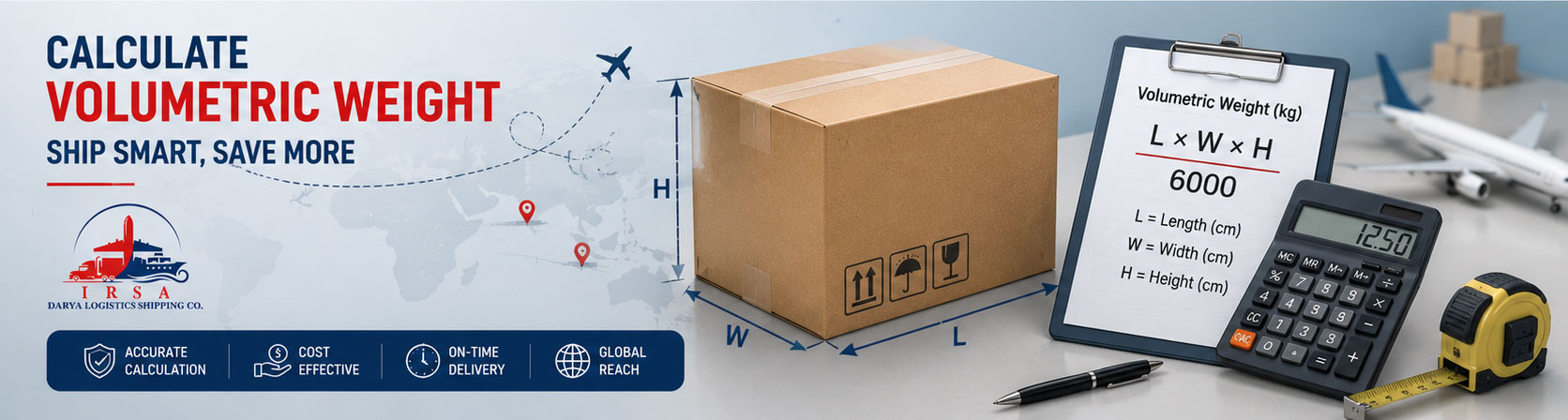
Length × Width × Height (cm) ÷ 6000 = Volumetric Weight (kg)
Most airlines use the divisor 6000 as the industry standard. However, some airlines and express courier companies may use different divisors such as 5000 or 4000.
Example 1: Calculating Volumetric Weight
Suppose a carton has the following dimensions:
- Length: 60 cm
- Width: 40 cm
- Height: 50 cm
The actual weight of the shipment is 12 kg.
Calculation:
60 × 40 × 50 = 120,000
120,000 ÷ 6000 = 20 kg
In this example, the actual weight is 12 kg, while the volumetric weight is calculated as 20 kg.
Therefore, the freight charge will be based on 20 kg.
Example 2: Calculating Volumetric Weight
Assume a package has the following dimensions:
- 80 × 60 × 40 cm
Actual weight:
45 kg
Volumetric weight calculation:
80 × 60 × 40 = 192,000
192,000 ÷ 6000 = 32 kg
In this case, the actual weight is 45 kg, while the volumetric weight is 32 kg.
Since the actual weight is greater, the shipping cost will be calculated based on 45 kg.
Sample Volumetric Weight Calculation Table
| Dimensions (cm) | Actual Weight | Volumetric Weight | Chargeable Weight |
|---|---|---|---|
| 60 × 40 × 50 | 12 kg | 20 kg | 20 kg |
| 80 × 60 × 40 | 45 kg | 32 kg | 45 kg |
| 40 × 40 × 40 | 15 kg | 10.7 kg | 15 kg |
| 100 × 80 × 60 | 35 kg | 80 kg | 80 kg |
Which Types of Cargo Usually Have High Volumetric Weight?
Some products have a relatively low actual weight but occupy a large amount of space, resulting in a higher volumetric weight. Examples include:
- Plastic components
- Toys
- Clothing and garments
- Foam products
- Mattresses and pillows
- Large cartons
- Home decoration items
- Artificial flowers
- Exhibition materials
The Difference Between Actual Weight and Volumetric Weight
| Actual Weight | Volumetric Weight |
|---|---|
| The physical weight of the shipment | The calculated weight based on volume |
| Measured using a scale | Calculated using a formula |
| Depends on the mass of the cargo | Depends on the dimensions of the cargo |
| Usually higher for dense cargo | Usually higher for bulky cargo |
Do All Airlines Use the Divisor 6000?
No. Although 6000 is the most commonly used divisor in the air freight industry, some airlines, express courier services, and logistics companies may use alternative divisors such as 5000, 4000, or their own internal standards. Therefore, it is always advisable to check the specific carrier’s calculation policy before shipping your cargo.
In addition, many airlines establish their freight calculation procedures according to the standards of the International Air Transport Association (IATA), which is recognized as the world’s leading authority for international air transportation regulations.